For it is from thee, O God, that all good things come--and from my God is all my health. This is what I have since learned, as thou hast made it abundantly clear by all that I have seen thee give, both to me and to those around me. For even at the very first I knew how to suck, to lie quiet when I was full, and to cry when in pain--nothing more.
Afterward I began to laugh--at first in my sleep, then when waking. For this I have been told about myself and I believe it--though I cannot remember it--for I see the same things in other infants. Then, little by little, I realized where I was and wished to tell my wishes to those who might satisfy them, but I could not! For my wants were inside me, and they were outside, and they could not by any power of theirs come into my soul. And so I would fling my arms and legs about and cry, making the few and feeble gestures that I could, though indeed the signs were not much like what I inwardly desired and when I was not satisfied--either from not being understood or because what I got was not good for me--I grew indignant that my elders were not subject to me and that those on whom I actually had no claim did not wait on me as slaves--and I avenged myself on them by crying. That infants are like this, I have myself been able to learn by watching them; and they, though they knew me not, have shown me better what I was like than my own nurses who knew me.
Source: The Confessions of Saint Augustine, Book 1
Showing posts with label books. Show all posts
Showing posts with label books. Show all posts
Friday, November 12, 2010
That Infants Are Like This
I love Augustine's perspective on babies--written all the way back in AD 397-98. Some things never change!


Monday, September 6, 2010
Al Mohler on Greeting Cards
 Smokey and I have been listening to Words from the Fire by Dr. R. Albert Mohler on the commute into work. We both couldn't help but laugh when Dr. Mohler shares this story:
A word of confession to those of the female gender. You need to know that we men are not good at the greeting card thing. We are not adept at this for several reasons. First, it is just hard to bring ourselves to pay that much for painted paper. Second, the words on the card don't match our kind of verbal expression—we just don't talk that way. Part of it is just the sheer embarrassment from realizing that we could never quite say all that florid prose with a straight face. Still, greeting cards do express something like what men want to express, and we do pay an unconscionable amount of money for this coated paper, which we then give to our loved one.On a more serious note, Smokey and I have also enjoyed listening to audio recordings of Dr. Mohler's blog, which he started doing periodically in response to a suggestion we submitted. We were disappointed when these recordings ceased, but we are excited about trying out the two new podcasts he is starting this month.
A few years ago, just days before the event, I realized I was in serious trouble because I was cardless for one of the major occasions of life—Mother's Day. So I quickly went and bought a card. I was successful in bringing home the card, signing the card, and even adding a personal note to my dear wife, Mary. I commented about her sweetness, fidelity, love, giving, and self-sacrifice, not only as my wife but as the mother of our children. I was even successful in remembering where the card was; and so, with great satisfaction (which is another one of the characteristics of the male of the species; when we actually remember to bring the card, there is inordinate self-satisfaction), I presented it to her. However, as Mary read the card, I noticed that her face did not match my expectation of what her face should betray.
So here are two rules of the greeting card thing I learned that day. Rule number one is remember to get the card. Rule number two is read the card before you give it. That is, read it thoroughly. In the expression of this greeting card I thanked my wife for so successfully blending together our two families—something that heretofore she had not been aware had been done. I had inadvertently chosen a "blended family" card without reading the message. My faux pas has become a part of our family lore. It is a part of my humiliation, and it is a part of my urgent exhortation to other husbands—read the card before you give it!
Last but not least, it's worth pointing out that Dr. Mohler has just started teaching verse-by-verse through the Book of Hebrews. I've added his Powerline podcast to my iTunes subscriptions and am hoping I'll find time to keep up.
Friday, October 23, 2009
The Housing Boom and Bust by Thomas Sowell
 Thomas Sowell's new book titled The Housing Boom and Bust sheds light on the origins of the recent financial crisis. If you are open to considering that government intervention in the housing market may actually create more problems than it solves, this is the book for you.
Sowell begins his argument by showing that a variety of local land-use restrictions are at the root of high housing costs, which he points out aren't truly a national problem. Even so, those higher costs lead to calls for federal government intervention, ignoring the fact that often government policies (at a local level) were largely to blame for unaffordable housing in the first place.
Sowell then shows how the resulting federal affordable housing policies, championed by both Democrats and Republicans, pressured banks and other lending institutions to loosen their lending standards so more people could participate in the "dream of homeownership." Whether these people could reasonably afford to repay their loans was for the most part ignored as the resulting speculative housing bubble grew and grew.
A few excerpts to pique your interest:
The decade of the 1970s saw a rapid spread of laws and policies in California severely restricting the use of land. Often these laws and policies forbade the building of anything on vast areas of land, in the name of preserving “open space,” “saving farmland,” “protecting the environment,” “historical preservation” and other politically attractive slogans. Moreover, these restrictions were extended to more and more land over the years....
While California was different from most of the rest of the country in the extent and severity of its land use restrictions, it was not unique. The same kinds of land-use restrictions...spread through various other places around the country... But, in whatever years building restrictions were tightened in various localities, those were usually the same years in which housing prices skyrocketed....
When the political crusade for affordable housing took off and built up steam during the 1990s, the share of their incomes that Americans were spending on housing in 1998 was 17 percent, compared to 30 percent in the early 1980s. Even during the housing boom of 2005, the median home took just 22 percent of the median American income....
Statistical studies about disparities between blacks and whites in mortgage loan approval rates might be said to have “jump-started” the housing crusades that began in the 1990s. Politicians and the media led this crusade, with many community activists following in their wake, much like scavengers, able to extract large sums of money from banks and other institutions by raising claims of discrimination, whose power to delay government approval of bank mergers and other business decisions made pay-offs to these activists the only prudent course for those accused....
If you want to understand the recent housing bubble, Sowell's new book is definitely a worthy read. Still not convinced? Take a look at this recent review at Kiplingers.com.When you open the floodgates, you cannot tell the water where to go. Housing speculators — “flippers” — found the new and looser home mortgage rules a bonanza. So did many others. It is by no means clear that the poor or minorities came out ahead at all, after the housing boom turned to bust and many were left with mortgage payments they couldn’t meet on homes they couldn’t afford.
Note: I also recommend Irrational Exuberance by Robert Shiller, which I blogged about earlier this year.
Wednesday, September 23, 2009
Stop Dating the Church
 I recently read a little book titled Stop Dating the Church by Joshua Harris and highly commend it to you. The strength of the book is not that Harris says anything that hasn't been said before, but instead that he provides an easy-to-read and concise argument for why professing believers should lay aside our independent and critical consumer mentality and instead begin to truly invest ourselves in a good local church.
Some of the most memorable and powerful words in the book are not from Harris but instead from his friends and mentors, like Pastor Mark Dever. Here's what Dever has to say on church membership:
“If you are not a member of the church you regularly attend, you may well be going to hell. I don’t mean for a second that you literally have to have your name on a membership card in a church somewhere to go to heaven. I believe in justification by faith alone in Christ alone by God’s grace alone. At the same time, in the New Testament is seems that the local church is there to verify or falsify our claims to be Christians. The man in 1 Corinthians 5 who was sleeping with his father’s wife thought of himself as a Christian."
"I don’t care how much you cry during singing or preaching. If you do not live a life marked by love toward others, the Bible has no encouragement for you to think that you’re a Christian. None."
"Do you want to know that your new life is real? Commit yourself to a local group of saved sinners. Try to love them. Don’t just do it for three weeks. Don’t just do it for six months. Do it for years. And I think you’ll find, and others will, too, whether or not you love God. The truth will show itself."
"Joining a church won’t save you. It’s only the death of Christ that saves you. He alone is our righteousness. But if He really is our righteousness, if we really love Him whom we have not seen, it will show itself by us loving those that we do see."
Harris also provides a list of ten important questions to ask when choosing a local church. I've listed the questions below, but I encourage you to take a look at this excerpt from the book if you'd like a fuller explanation of any particular point (like question #9, for instance).
- Is this a church where God’s Word is faithfully taught?
- Is this a church where sound doctrine matters?
- Is this a church in which the gospel is cherished and clearly proclaimed?
- Is this a church committed to reaching non-Christians with the gospel?
- Is this a church whose leaders are characterized by humility and integrity?
- Is this a church where people strive to live by God’s Word?
- Is this a church where I can find and cultivate godly relationships?
- Is this a church where members are challenged to serve?
- Is this a church that is willing to kick me out?
- Is this a church I’m willing to join “as is” with enthusiasm and faith in God?
Wednesday, January 28, 2009
Irrational Exuberance
I know I'm a few years late to the party on this one, but I finally got around to checking out Irrational Exuberance by Robert Shiller, a book I've been wanting to read for some time. Shiller has earned quite the reputation in recent years by being one of the first economists to point out speculative bubbles in the both the stock market and the real estate market--before they burst. That gives him a lot more credibility in my mind than the average talking head on television.
I'm about 100 pages in, and so far I've found the book to be accessible and packed with helpful and thought-provoking historical data. Here's an interesting excerpt from the book (as republished in this interview):
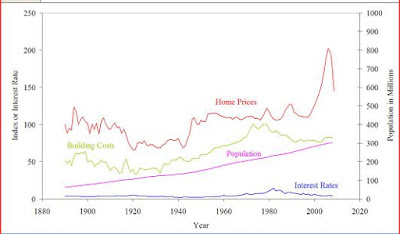
Schiller has been updating some of the data and graphs from his book at http://www.irrationalexuberance.com/. It's fascinating to see where stock prices and housing prices are now in relation to where they've been over the past 100 plus years. The image below is his updated graph of real home prices through mid-2008.
I'm about 100 pages in, and so far I've found the book to be accessible and packed with helpful and thought-provoking historical data. Here's an interesting excerpt from the book (as republished in this interview):
It is true that, for the United States as a whole, real home prices were 66% higher in 2004 than in 1890, according to the index my research assistants and I have put together. But all of that increase occurred in two brief periods: the time right after World War II and since 1998. Other than those two periods, real home prices overall have been mostly flat or declining. Moreover, the overall increase, including the booms, is not very impressive — 0.4% a year.
Why then do so many people have the impression that home prices have done so well? People remember the prior purchase price of a home from long ago and are surprised at the difference between then and now. In closing out the estate of an elderly person, one may be surprised to see that he purchased a house in 1948 for $16,000 and that the estate sold the house in 2004 for $190,000. The appearance is that the investment in the house did extremely well. But the consumer price index rose eightfold between 1948 and 2004, so the real increase in value was only 48%, or less than 1% a year.
Schiller has been updating some of the data and graphs from his book at http://www.irrationalexuberance.com/. It's fascinating to see where stock prices and housing prices are now in relation to where they've been over the past 100 plus years. The image below is his updated graph of real home prices through mid-2008.

Saturday, January 10, 2009
Bookaway
Since we have too many books and not enough time to read them, we've invited a few friends to join us in giving away books for free at www.bookaway.blogspot.com.
If you'd like a chance at winning some free books in the weeks and months ahead, be sure to bookmark the site or add it to your Google Reader account. Also, if you are interested in giving away some of your own books on the site, please let us know. We would welcome a few additional co-bloggers who have good taste in books.
Finally, please help us spread the word by telling others about Bookaway.

Saturday, January 5, 2008
Free Audiobook of the Month: Paradise Lost
From Christianaudio.com:
Free Audiobook of the Month: Paradise Lost by John Milton.
An English cleric with a classical education, Milton lost his eyesight in 1652, and thus the story was largely dictated by the blind poet, lending a certain quality of the ancient oral epics, which only serves to enhance the telling of the tale. Weaving classical mythology with a deep knowledge and reference to Scripture, Milton's genius for narrative unfolds what his biographer, Samuel Johnson, called his "peculiar power to astonish."
Nadia May has narrated over five hundred audiobooks and has earned the prestigious AudioFile Golden Voice award, as well as fourteen Earphone awards. She is an accomplished film, TV, and theater actress. Her native British voice complements her graduate education in English Literature from UC Berkeley to make her delivery of John Milton's Paradise Lost engaging and nuanced.
Simply add the Download Format of Paradise Lost to your cart and then use the coupon code JAN2008 during checkout to receive your free download.


Tuesday, October 9, 2007
Win R.C. Sproul Books
Enter to win 40 copies of R.C. Sproul's most recent book, The Truth of the Cross.
Monday, October 1, 2007
New Giveaway: Grisham Novel
 In light of Christina's jury duty today, it seems fitting to do a new giveaway in honor of those brave men and women across America who leave their homes and workplaces to serve on a jury.
Be the first to leave a comment claiming today's giveaway, and you win a free hardcover copy of The Runaway Jury by John Grisham.
According to the Amazon.com book review:
Millions of dollars are at stake in a huge tobacco-company case in Biloxi, and the jury's packed with people who have dirty little secrets. A mysterious young man takes subtle control of the jury as the defense watches helplessly, but they soon realize that he in turn is controlled by an even more mysterious young woman. Lives careen off course as they bend everyone in the case to their will.
Saturday, June 23, 2007
Piper for $5
 This Wednesday and Thursday (June 27-28) Desiring God Ministries is offering all books by John Piper for only $5 each. If you haven't read anything by Piper before, this is a great opportunity to check him out.
As part of my Friday morning Bible study, we've read Desiring God and are currently reading Let the Nations be Glad! I highly recommend both.
If you've read any books by Piper that you would recommend, please feel free to leave a comment.
Subscribe to:
Posts (Atom)